
Polyclonal Epitope Mapping.
Decode the Polyclonal Immune Response by characterizing epitopes directly from purified IgG fractions. Accelerate vaccine design and development with resolution at the amino acid level.
How Polyclonal Epitope Mapping Works.
The Polyclonal “Black Box”
Traditional vaccine design often focuses on predefined antigen regions and does not account for the specific epitopes targeted by an individual’s natural immune response. Understanding these naturally immunodominant epitopes is critical for developing vaccines that more effectively mimic protective immunity. However, identifying the dominant epitopes recognized by polyclonal antibody responses has remained a significant technical challenge because patient sera contain complex mixtures of antibodies that bind multiple regions of the antigen simultaneously.
Our Polyclonal Epitope Mapping Workflow
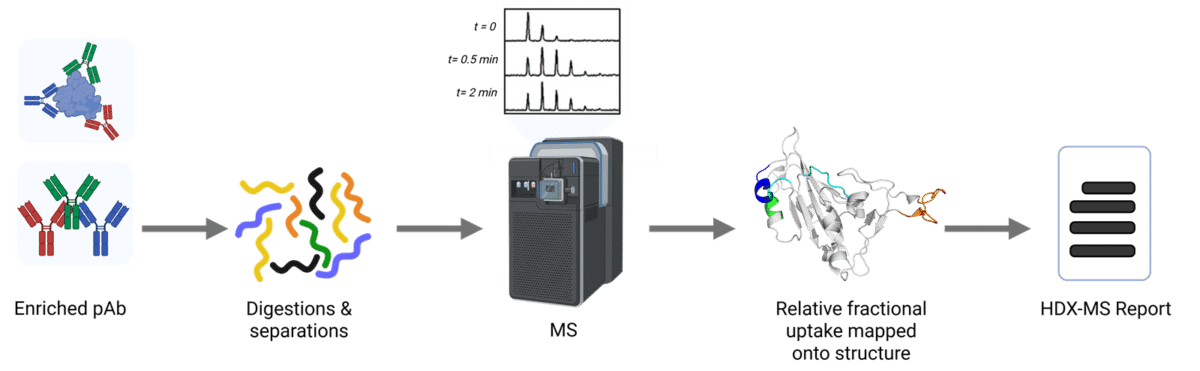
Our specialized workflow captures the functional polyclonal pool directly from a purified IgG fraction of immunoserum. We perform Hydrogen Deuterium Exchange Mass Spectrometry (HDX-MS) to compare the antigen in its free state, with the bound state under various concentrations and time points. This reveals a distinct pattern of binding.
Applications of Polyclonal Epitope Mapping.
Vaccine design.
Map Correlates of Protection: Identify the specific epitopes or structural domains targeted by protective immune response in animal models or clinical trial cohorts.
Epitope Steering & Immunogen optimization: Evaluate if structural modifications to an immunogen successfully redirect the polyclonal response toward desired, neutralizing epitopes rather than non-neutralizing decoy regions.




Drug target discovery and validation.
Evaluate which epitopes are important to the intended biological pathway by examining the polyclonal epitope coverage from convalescent patients.
Drug development, immunogenicity studies.
Study patients’ Anti-Drug Antibody (ADA) responses to the drug, to understand if/how the immune response interferes with the drug’s activity (efficacy) or clearance.

Getting Started.
Requirements
Antigen:
- Minimum 300 µg
- 90% purity (determined by SDS-PAGE or SEC).
- Preferable molecular weight < 150 kDa
Polyclonal antibodies:
- Minimum 500 µg pAb
- Must be the antigen-affinity purified IgG fraction isolated from immunoserum (crude serum or antiserum cannot be run directly, but ask us for purification options).
Talk to Our Scientists.
We Have Sequenced 10,000+ Antibodies and We Are Eager to Help You.
Through next generation protein sequencing, Rapid Novor enables reliable discovery and development of novel reagents, diagnostics, and therapeutics. Thanks to our Next Generation Protein Sequencing and antibody discovery services, researchers have furthered thousands of projects, patented antibody therapeutics, and developed the first recombinant polyclonal antibody diagnostics.
Other HDX-MS Epitope Mapping Services.
HDX-MS Epitope Mapping
- Detailed epitope mapping analysis for 1 antibody-antigen pair.
- Requirements: Antigen 200 μg, Antibody 200 μg, Antigen sequence
- Add ons: AI predictions, Paratope mapping, additional mAbs
- Turn around time: 3-4 weeks
HDX-MS Epitope Screening
- Epitope mapping for 10 – 50 antibodies against one antigen.
- Requirements: Antigen 500 μg, Antibodies 100 μg each, Antigen sequence
- Add ons: additional antibodies, paratope mapping
- Turn around time: 3-6 weeks
HDX-MS + AI Epitope Analysis
- Epitope mapping for 100’s of antibodies against one antigen.
- Requirements: Antigen 500 μg, Antibodies 100 μg each, Antibody sequences, Antigen 3D structure
- Add ons: additional antibodies
- Turn around time: 4-6 weeks
Customized HDX-MS Projects
- Custom analysis of protein complexes, conformation changes, ligands and other structural questions.
- Please inquire about experiment design, and sample requirements.
Talk to Our Scientists.
We Have Sequenced 9000+ Antibodies and We Are Eager to Help You.
Through next generation protein sequencing, Rapid Novor enables timely and reliable discovery and development of novel reagents, diagnostics, and therapeutics. Thanks to our Next Generation Protein Sequencing and antibody discovery services, researchers have furthered thousands of projects, patented antibody therapeutics, and ran the first recombinant polyclonal antibody diagnostics
Talk to our scientists. We have sequenced over 9000+ antibodies and we are eager to help you.
The Science of Epitope Mapping.
Antibody Sequencing & Discovery Services.

Antibody Sequencing, Discovery and Characterization Services.
Antibody Sequencing & Discovery Services.
REmAb® mAb Sequencing
Monoclonal antibody sequencing from small antibody samples, no need for hybridoma or DNA information. Full sequence in record time.
Explore Antibody Sequencing Services

REpAb® pAb Sequencing
Polyclonal antibody sequencing and antibody discovery service. Sequence antibodies from blood or a polyclonal mixture.
Explore Antibody Discovery Services

RapidSPR™ Analysis
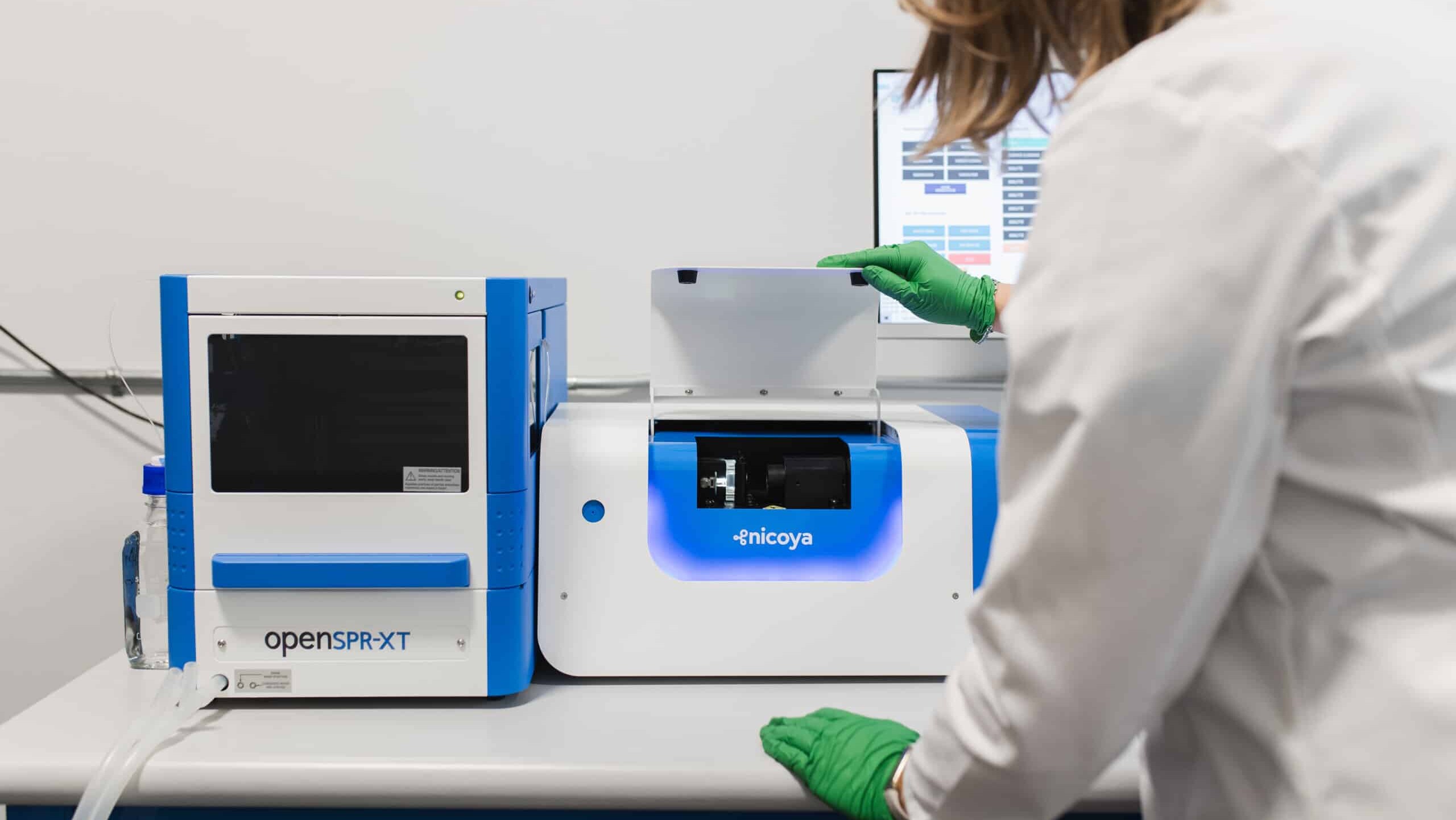
Label-free evaluation of antibody-antigen binding using surface plasmon resonance on Biacore or Nicoya. Can be employed for detailed kinetic profiling, kinetics screening, or epitope binning.
Explore SPR Services
RapidHDX-MS™
Mass spec based epitope mapping. Epitope mapping for identify the binding site of an antibody to its corresponding antigen with the highest confidence and resolution.
Explore HDX-MS Epitope Mapping Service
MATCHmAb™
Antibody verification by rapid peptide mapping. Antibody sequence confirmation and full detailed mapping for development purposes.
Explore Peptide Mapping Service
Antibody Characterization
LC-MS analysis for study of antibody glycosylation, disulfide bonds, post-translational modifications, sequence variants, intact mass and size.
Explore Antibody Characterization Services