
Antibody Cross-Reactivity Analysis by SPR.
Comparing binding affinity across human, cynomolgus, and mouse targets for IND-enabling studies.
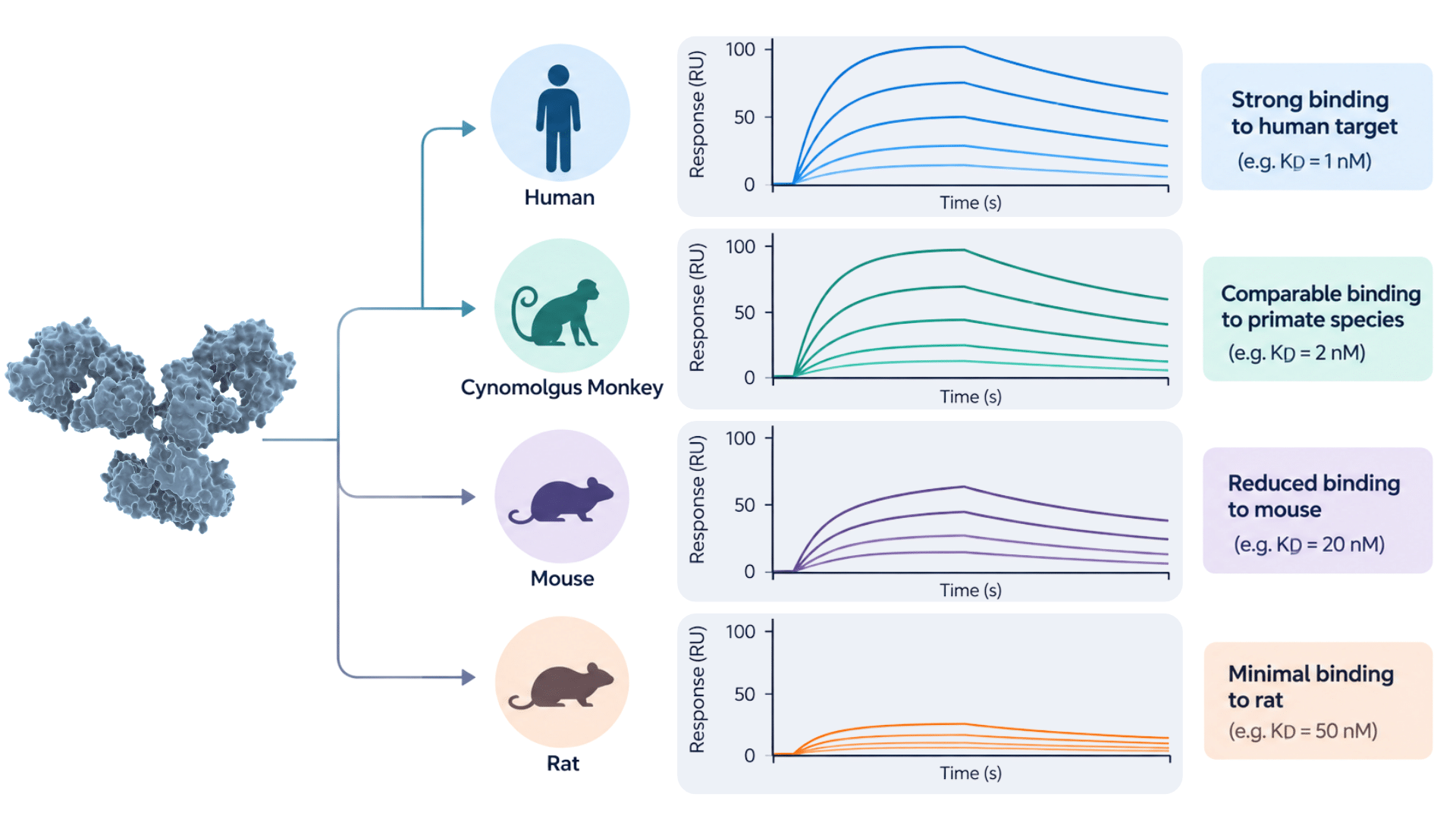
Interspecies cross-reactivity is a critical step in pre-clinical antibody development. Before advancing to IND-enabling toxicology studies, it is essential to determine which animal species are suitable for evaluating your therapeutic antibody.
By comparing binding affinity across human and relevant animal species (such as cynomolgus monkey, mouse, and rat), you can identify appropriate in vivo models and assess potential off-target binding risks.
Make informed decisions with reliable binding data. Characterizing cross-species reactivity provides the evidence needed to support animal model selection, strengthen preclinical study design, and inform regulatory submissions.
- IND-Enabling Study Compliance: Regulatory agencies require evidence that the animal model chosen for toxicology studies accurately reflects the target binding profile of the human therapeutic.
- Selecting the Right Animal Model: Not all animal models are suitable for every target. Cross-reactivity studies allow you to confirm whether your antibody binds to the orthologs in common laboratory species or non-human primates, ensuring your toxicology data is translational and relevant.
- Safety and Off-Target Risk Assessment: Identifying cross-reactivity with unwanted targets or unexpected species variability helps in early-stage risk mitigation, reducing the likelihood of failure during later clinical stages.
- Translational Research: For academic and biopharma researchers, confirming binding across species validates that the interaction mechanism is conserved, strengthening the biological relevance of your data.
- Quantitative Comparison: SPR provides specific KD, ka, and kd values for each species. This allows you to differentiate between “strong binding” and “moderate binding,” which is essential for determining which species is a true pharmacological surrogate.
- High Sensitivity: Our Biacore 1k platform can detect binding interactions even when affinities are lower or when antigen availability is limited, providing clarity where other assays might show false negatives.
The Rapid Novor Advantage.
Getting Started.
Requirements
To begin your interspecies cross-reactivity study, we typically require:
- Antibodies: A purified monoclonal antibody or antibody fragment (>90% purity).
- Antigens: The target antigens from the desired species (e.g., Human, Cyno, Mouse, Rat, etc.).
Need help sourcing species-specific antigens or optimizing the assay?
Reach out to our scientists, we are experienced in managing challenging project requirements.
Talk to Our Scientists.
We Have Sequenced 10,000+ Antibodies and We Are Eager to Help You.
Through next generation protein sequencing, Rapid Novor enables reliable discovery and development of novel reagents, diagnostics, and therapeutics. Thanks to our Next Generation Protein Sequencing and antibody discovery services, researchers have furthered thousands of projects, patented antibody therapeutics, and developed the first recombinant polyclonal antibody diagnostics.
Talk to Our Scientists.
We Have Sequenced 9000+ Antibodies and We Are Eager to Help You.
Through next generation protein sequencing, Rapid Novor enables timely and reliable discovery and development of novel reagents, diagnostics, and therapeutics. Thanks to our Next Generation Protein Sequencing and antibody discovery services, researchers have furthered thousands of projects, patented antibody therapeutics, and ran the first recombinant polyclonal antibody diagnostics
Talk to our scientists. We have sequenced over 9000+ antibodies and we are eager to help you.
Antibody Sequencing, Discovery and Characterization Services.
Antibody Sequencing & Discovery Services.
REmAb® mAb Sequencing
Monoclonal antibody sequencing from small antibody samples, no need for hybridoma or DNA information. Full sequence in record time.
Explore Antibody Sequencing Services

REpAb® pAb Sequencing
Polyclonal antibody sequencing and antibody discovery service. Sequence antibodies from blood or a polyclonal mixture.
Explore Antibody Discovery Services

RapidSPR™ Analysis
Label-free evaluation of antibody-antigen binding using surface plasmon resonance on Biacore or Nicoya. Can be employed for detailed kinetic profiling, kinetics screening, or epitope binning.
Explore SPR Services
RapidHDX-MS™
Mass spec based epitope mapping. Epitope mapping for identify the binding site of an antibody to its corresponding antigen with the highest confidence and resolution.
Explore HDX-MS Epitope Mapping Service
MATCHmAb™
Antibody verification by rapid peptide mapping. Antibody sequence confirmation and full detailed mapping for development purposes.
Explore Peptide Mapping Service
Antibody Characterization
LC-MS analysis for study of antibody glycosylation, disulfide bonds, post-translational modifications, sequence variants, intact mass and size.
Explore Antibody Characterization Services