


Rapid Novor Technical Note | REpAb Platform Series
Authors: Chelsea Reitzel, Thierry Le Bihan
Published: April 7, 2026
Abstract
Clients submitting serum/plasma samples for REpAb antibody sequencing face two practical challenges:
This technical note addresses both problems. We demonstrate that X₅₀, the dilution factor at 50% maximal ELISA signal, can be used to roughly estimate antigen-specific polyclonal antibody (pAb) concentration in serum/plasma, and that this can be used to estimate the serum/plasma volume required to obtain 1 mg of pAb for REpAb input. Using anti-RBD antibody spiked into naïve serum/plasma to generate a reference calibration curve, the concentration of a representative mid-range pAb sample was estimated within ~5% error. We further describe a reference normalization approach to harmonize titer values across laboratories using different ELISA protocols, enabling clients to apply this framework regardless of how their titers were measured.
Background
The REpAb Input Requirement
REpAb, Rapid Novor’s polyclonal antibody repertoire sequencing platform, requires a minimum of 1 mg of antigen-enriched pAb as input to ensure adequate immune repertoire representation and robust downstream proteolytic experiments. Because antigen-specific antibody concentrations vary widely between donors, species, antigens, and immunization protocols, the volume of serum/plasma required to meet this threshold can range from as little as 3 mL to well over 100 mL (in a specific case, a liter was needed).
This variability creates a dilemma for clients at the planning stage: how much serum/plasma should be collected and shipped? Without an early quantitative estimate, clients either over-collect (wasting precious biological material) or under-collect (leading to project failure or delay).
Two Problems This Note Addresses
Decision Framework: Which Scenario Applies to You?
Before proceeding to the quantitative details, identify which of the three scenarios below best describes your situation.
| Scenario | Your Situation | Go To |
|---|---|---|
| A: “Unlimited” serum/plasma | You have ample serum/plasma and want to know how much to send based on your titer. | Results → Table 1 |
| B: Limited serum/plasma | You have a fixed volume. You need to know if it’s enough, and what yield to expect. | Results → Initial Decision |
| C: External titre | You have a titer from your own lab and need to map it to this framework. | Inter-Lab Harmonization |
Why X₅₀ as a Quantitative Metric?
X₅₀ represents the serum/plasma dilution factor at which the ELISA signal reaches 50% of its maximum binding value. It is determined by performing a serial dilution ELISA, fitting the resulting sigmoidal curve to a four-parameter logistic (4PL) regression model, and extracting the inflection point of the curve (analogous to an EC₅₀). The remaining parameters of the 4PL model include the minimum response, maximum response, and Hill coefficient, which describes the slope of the curve at the inflection point.
Alternative metrics were considered, including the dilution at which the maximum signal (ODmax) is observed, the Hill coefficient, endpoint titer (defined as the highest dilution producing a detectable signal, typically ≥3 standard deviations above background), and area under the curve. However, X₅₀ was selected because it exhibits a strong linear relationship with antibody concentration and is expected to be less susceptible to signal saturation artifacts at high concentrations compared with endpoint-based measurements (Fig. 1).
Importantly, X₅₀ is also less sensitive to inter-lab protocol variation than endpoint titer, because it is derived from the shape of the full dilution curve rather than a single threshold crossing. This makes it a more transferable metric across laboratories, particularly when combined with the normalization approaches described below.
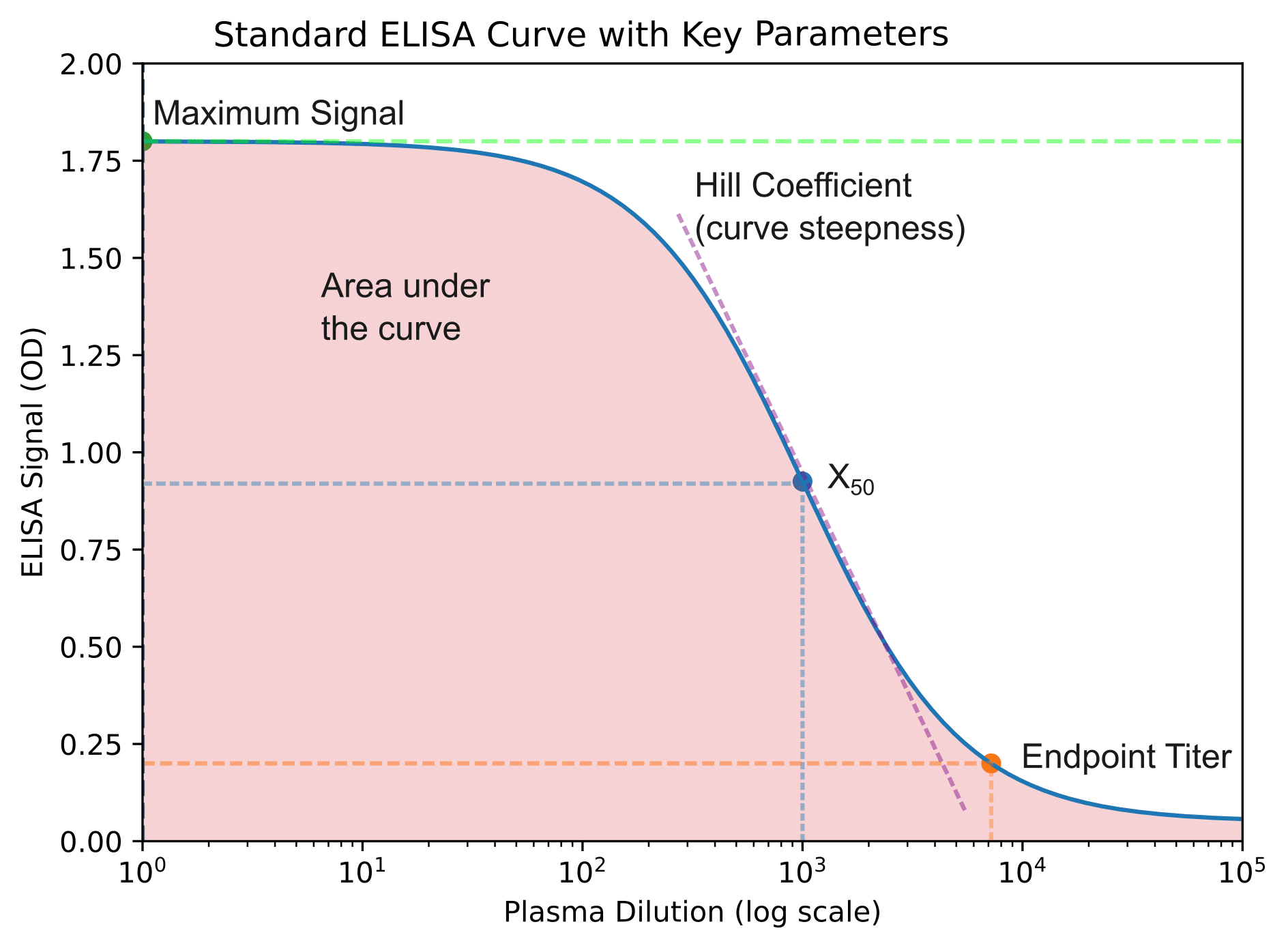
Figure 1: Key parameters of an ELISA titration curve, with X₅₀ highlighted as the preferred quantitative metric
Methods
Serum/Plasma Dilution ELISA
High-binding 96-well plates were coated with antigen at 2 µg/mL in sodium carbonate-bicarbonate buffer (100 µL/well), incubated at room temperature for 20 minutes with shaking, then overnight at 4°C. Plates were washed three times with ELISA wash buffer (200 µL/well) and blocked with Superblock for 1 hour at room temperature. Following washing, serum/plasma samples were serially diluted in Stabilzyme diluent from 1:10 through 1:30,000 (1:10, 1:30, 1:100, 1:300, 1:1,000, 1:3,000, 1:10,000, 1:30,000) and added in duplicate at 100 µL/well. After 1 hour incubation and washing, an HRP-conjugated secondary antibody (goat anti-human IgG or mouse anti-rabbit IgG) was added at manufacturer-recommended dilution and incubated for 1 hour. Colorimetric detection used TMB (3,3′,5,5′-tetramethylbenzidine) substrate (3 min, room temperature) stopped with 0.2 N H₂SO₄. Absorbance was measured at 450 nm (Synergy LX, BioTek). Reaction was stopped before signal reached 2.0 OD units to ensure that all curves were within linear detection range.
pAb Concentration Standard Curve
A recombinant anti-RBD monoclonal antibody was spiked into naïve rabbit and human serum/plasma at concentrations corresponding to 0.1%, 1%, and 3% of total IgG content. This yielded concentrations of 2.7, 27, and 81 µg/mL (rabbit) and 11.9, 119, and 357 µg/mL (human). Serum/Plasma dilution ELISAs were performed for all six spike-in conditions and curves were fitted with a 4PL regression model to extract X₅₀. These values were plotted against known concentrations to generate a reference linear calibration curve. Two test samples (one human, one rabbit) were evaluated under identical conditions to assess predictive accuracy.
Results and Discussion
Standard Curve: X₅₀ Estimates pAb Concentration
Across all six spike-in conditions, X₅₀ and pAb concentration followed a linear relationship (y = 6.7x + 53.4, Fig. 2), where y = X₅₀ and x = pAb concentration (µg/mL). This equation can be used to interpolate concentration from X₅₀ values. Data for the rabbit and human standard curves were pooled after confirming parallelism (i.e., no species-dependent slope deviation), resulting in a strong linear trend with R2 = 0.9936. Two unknown test samples were evaluated against this curve.
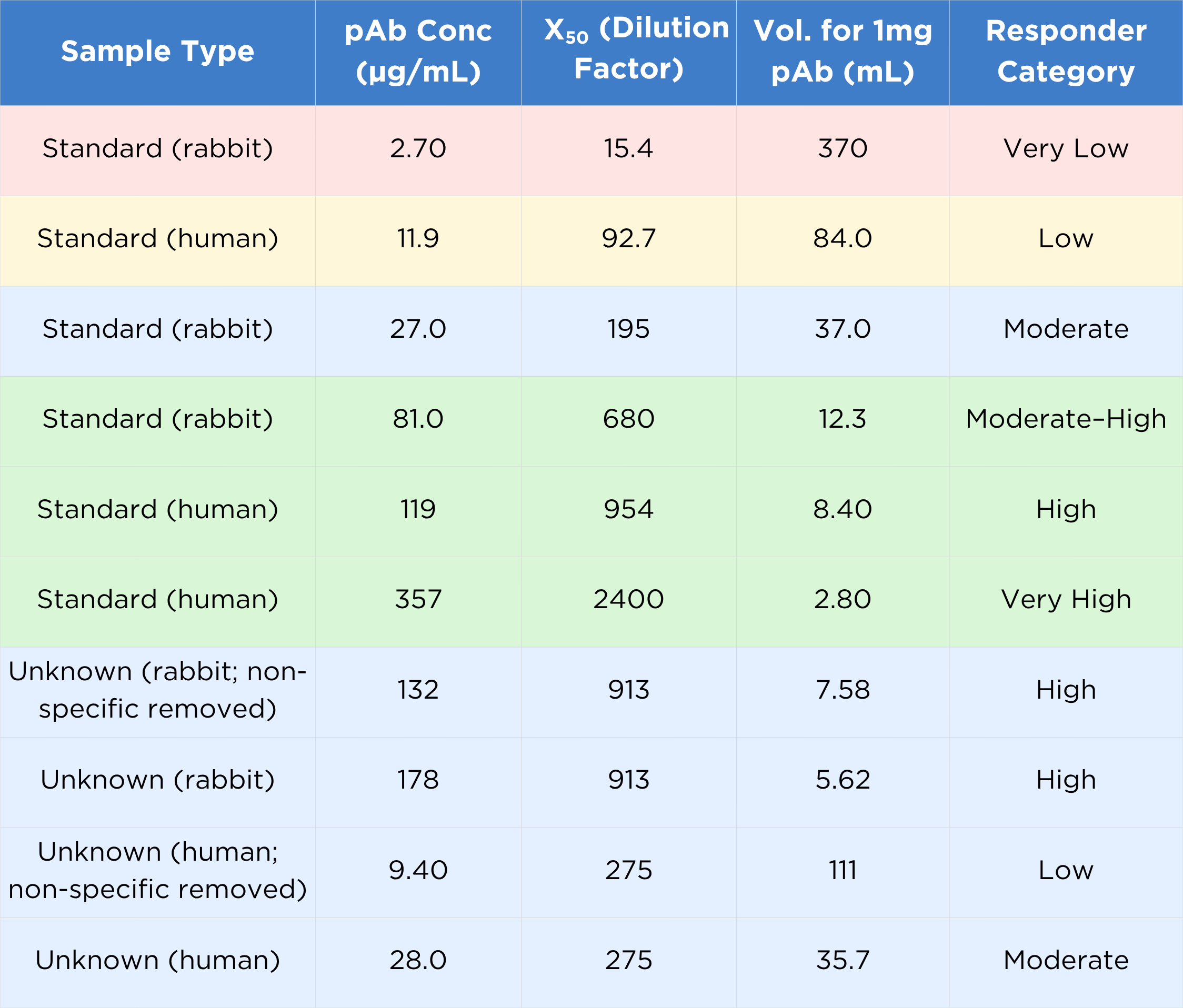
The rabbit sample performed as expected: X₅₀ = 892, estimated concentration 125 µg/mL, actual 132 µg/mL, a ~5% error (Table 1). This level of accuracy is well suited for serum/plasma volume planning. The human sample, however, revealed an important limitation of the method: X₅₀ = 275, predicted 33 µg/mL, actual 9.4 µg/mL, a 3.5-fold overestimate (Table 1). This is not a random error but a predictable consequence of the linear model at low concentrations: when pAb content is low, the ELISA signal is dominated by background and non-specific binding, inflating the apparent X₅₀ relative to true antibody content. The linear regression, which was calibrated across a wide concentration range, does not adequately constrain the low end. Notably, non-specific binders are removed by passing the enriched pAb fraction over a blank column, which captures antibodies that interact with plastic or resin components rather than the antigen. We report pAb concentrations both before and after this depletion step (Table 1). The X₅₀ values remain the same in both cases because X₅₀ is determined from the serum/plasma dilution ELISA; the depletion step is applied later during antigen enrichment and is not performed on the serum/plasma used to calculate X₅₀.
The practical implication is direct: X₅₀-based estimation is useful for moderate-to-high responders but could overestimate pAb concentration in low-responder samples. For samples with X₅₀ < 200, the estimated concentration should be treated as an optimistic upper bound. In these cases, we recommend shipping at least twice the estimated volume, or contacting Rapid Novor to discuss whether additional immunization or a repeat bleed would better serve the project.

Figure 2: Standard curve relating X₅₀ to pAb concentration for anti-RBD mAb spiked into naïve human and rabbit serum/plasma. Dotted lines represent the 95% confidence interval. Real sample data points are also shown.
Table 1: X₅₀, Estimated pAb Concentration, and Required Serum/Plasma Volume
Table 1 presents the full dataset in both directions: forward (concentration → volume needed) and as a reference for reverse lookup (volume available → expected yield).
Initial Decision Framework (Scenario B: Limited Serum/Plasma)
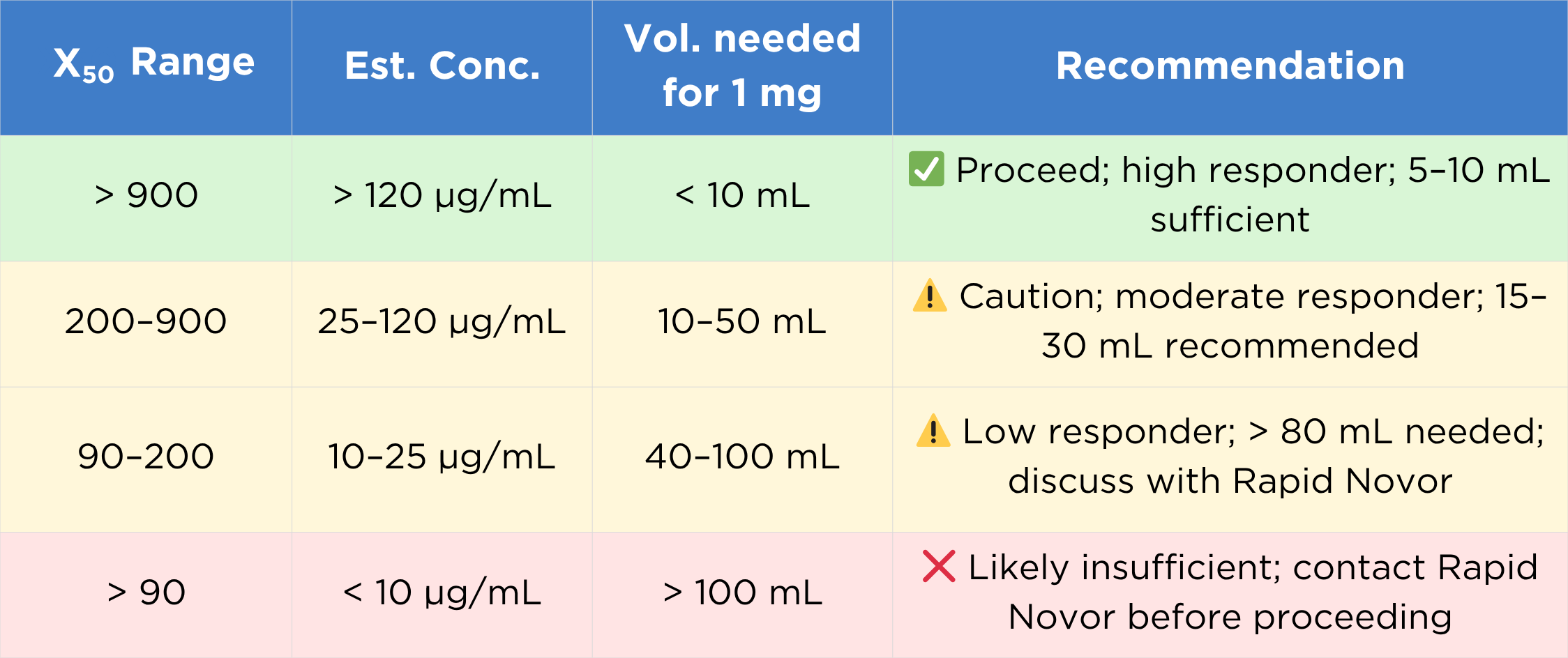
For clients with a fixed serum/plasma volume, the decision logic inverts, rather than asking how much serum/plasma to collect, the question is whether the serum/plasma on hand is likely to yield sufficient pAb. The framework below translates X₅₀ and available volume into an actionable recommendation.
Table 2: Serum/Plasma Volume Planning Guide Based on X₅₀ Titer
Inter-Laboratory Titer Harmonization (Scenario C)
The standard curve in this note was generated using a specific ELISA protocol (see Methods). Clients using different coating concentrations, blocking buffers, secondary antibodies, or incubation times will generate X₅₀ values that are not directly comparable to this curve. Three approaches are available, in order of increasing precision:
Option 1 Submit Raw ELISA Data (Recommended)
Send your raw OD-vs-dilution data to Rapid Novor. We will apply our standardized 4PL curve fitting to extract a calibrated X₅₀ and map it directly to our standard curve. This approach controls the analytical step regardless of upstream ELISA protocol variation and requires no additional work on your part.
Option 2 Spike-In Reference Normalization
If you prefer to use your own ELISA setup, include a reference control: spike a commercial anti-target antibody at a known concentration into your own naïve serum/plasma matrix (ideally at three concentrations spanning your expected range). Run this alongside your test sample. Calculate the X₅₀ of the reference and express your test sample’s X₅₀ as a ratio to the reference. This relative value can then be mapped to the Rapid Novor standard curve in a protocol-independent way. We recognize this approach requires additional reagents and ELISA runs that may not always be practical. If a commercial antibody against your target is unavailable, or if running reference spike-ins is not feasible within your workflow, Option 3 below provides a simpler alternative with appropriate caveats.
Option 3 Order-of-Magnitude Estimate
If neither option above is feasible, X₅₀ from your own protocol can still provide a rough order-of-magnitude estimate of responder category. Use the initial assessment table with a conservative interpretation: treat your sample as one responder category lower than your X₅₀ suggests, and plan serum/plasma volumes accordingly. This approach should not be used for precise volume calculations but is useful for early go/no-go screening.
Practical Workflow Summary
The complete workflow integrates four steps:
- Quantify: Run a serial dilution ELISA on your serum/plasma sample to generate a binding curve.
- Estimate: Fit the curve (or send data to Rapid Novor) to extract X₅₀. Interpolate against the standard curve to estimate pAb concentration.
- Plan: Use Table 2 or the Go/No-Go framework to determine the serum/plasma volume to ship or assess whether your available volume is sufficient.
- Sequence: Proceed to antigen-specific enrichment and REpAb sequencing in your input quantities.
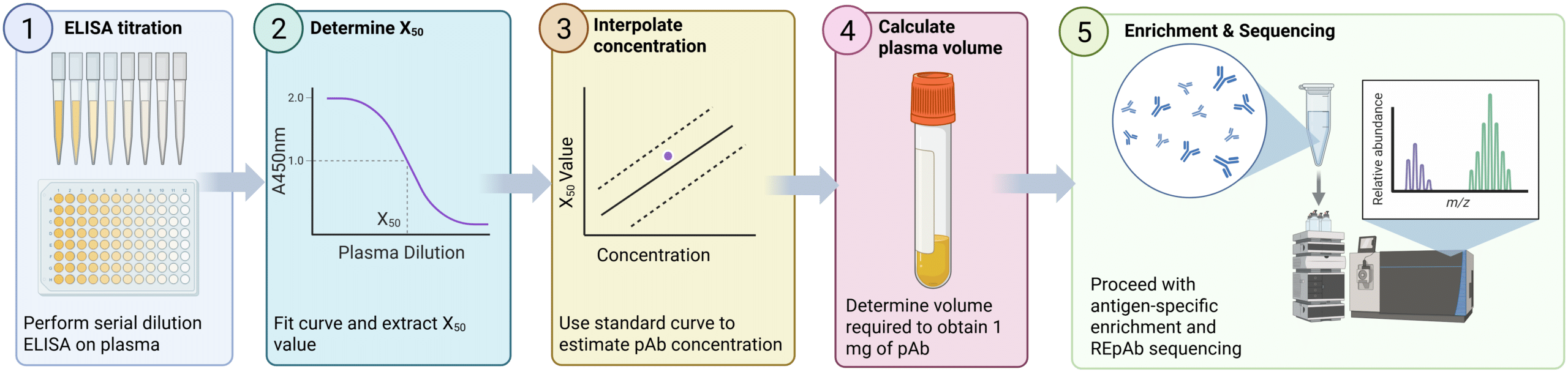
Figure 3: Workflow diagram: Quantify → Estimate → Plan → Sequence
Conclusion
X₅₀ values derived from ELISA titration curves provide a scalable tool for estimating antigen-specific pAb concentration in serum/plasma without requiring prior purification or reference antibodies from clients. By establishing a reference calibration curve, this framework enables two critical decisions before any enrichment or sequencing begins: whether a given serum/plasma volume is sufficient to proceed, and how much serum/plasma to collect when planning is done prospectively.
The inter-laboratory harmonization approaches described here extend the utility of this method to clients using diverse ELISA setups, making X₅₀-based serum/plasma planning broadly applicable regardless of the originating laboratory’s specific protocol.
In short, this transforms ELISA from a qualitative immune response check into a semi-quantitative planning instrument enabling confident, evidence-based decisions at the earliest stage of the REpAb workflow. These estimates are intended for planning purposes and may be less accurate for low-abundance samples.
References
Dogan, M., Kozhaya, L., Placek, L. et al. SARS-CoV-2 specific antibody and neutralization assays reveal the wide range of the humoral immune response to virus. Commun Biol 4, 129 (2021). https://doi.org/10.1038/s42003-021-01649-6
Matsuura, T., Fukushima, W., Nakagama, Y. et al. Factors impacting antibody kinetics, including fever and vaccination intervals, in SARS-CoV-2-naïve adults receiving the first four mRNA COVID-19 vaccine doses. Sci Rep 14, 7217 (2024). https://doi.org/10.1038/s41598-024-57931-0

Talk to Our Scientists.
We Have Sequenced 10,000+ Antibodies and We Are Eager to Help You.
Through next generation protein sequencing, Rapid Novor enables reliable discovery and development of novel reagents, diagnostics, and therapeutics. Thanks to our Next Generation Protein Sequencing and antibody discovery services, researchers have furthered thousands of projects, patented antibody therapeutics, and developed the first recombinant polyclonal antibody diagnostics.
Talk to Our Scientists.
We Have Sequenced 9000+ Antibodies and We Are Eager to Help You.
Through next generation protein sequencing, Rapid Novor enables timely and reliable discovery and development of novel reagents, diagnostics, and therapeutics. Thanks to our Next Generation Protein Sequencing and antibody discovery services, researchers have furthered thousands of projects, patented antibody therapeutics, and ran the first recombinant polyclonal antibody diagnostics