
Paratope Mapping Services.
High-resolution paratope mapping by mutagenesis, with kinetic differences quantified by SPR. HDX-MS provides orthogonal paratope identification and focuses library generation for cost-efficiency and increased scientific rigor.
How it Works.
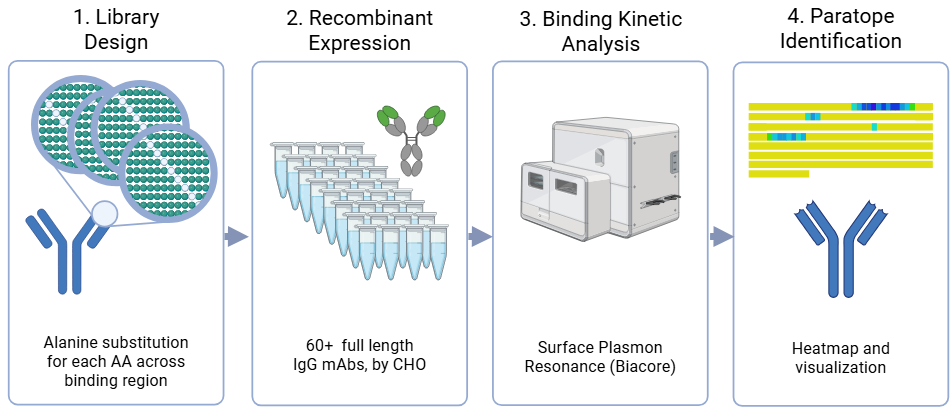
Our workflow begins with targeted antibody mutant library generation expressed in mammalian CHO cells to ensure native folding and proper disulfide pairing. High-throughput purification and rigorous quality control confirm structural integrity before kinetic testing.
Deployed on our optimized Biacore 1K system, Single-Cycle Kinetics (SCK) measures key kinetic parameters (kon, koff, KD) across the mutant library. The resulting binding data is compiled into high-density residue heatmaps and actionable biophysical reports to highlight critical binding hotspots.
This workflow systematically substitutes individual amino acid residues across all six complementarity-determining regions (CDRs)—CDR-H1, CDR-H2, CDR-H3, CDR-L1, CDR-L2, and CDR-L3—with alanine (or glycine for native alanines). Expressed via recombinant CHO cells and screened using Biacore Single-Cycle Kinetics (SCK), this comprehensive scan identifies critical energetic contact points and establishes a baseline functional map of the binding interface.
Ideal Application: earlier stages of antibody discovery, lead selection, and early-stage candidate characterization to guide initial affinity maturation and framework grafting.
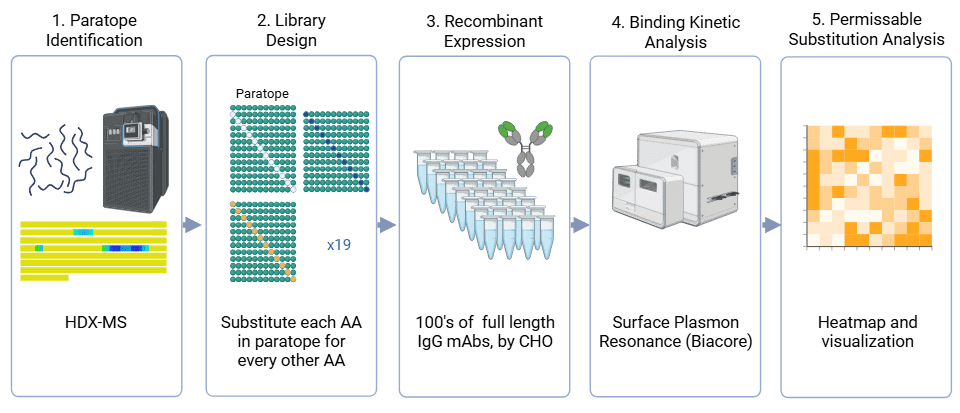
This multi-modal workflow first utilizes Hydrogen-Deuterium Exchange Mass Spectrometry (HDX-MS) to narrow down the precise dynamic interaction interface and solvent-shielded CDR regions. Once the paratope footprint is defined, targeted site-saturation mutagenesis (SSM) evaluates all possible amino acid substitutions at each critical residue position, followed by SPR kinetic analysis.
Ideal Application: late-stage lead optimization and IP protection. By identifying both permissible and disruptive mutations across the binding interface, this workflow establishes the experimental proof required to support broad patent claims and de-risk downstream manufacturability.
The Rapid Novor Advantage for Paratope Mapping.
Antibody Intellectual Property Protection.
Watch our Webinar on Rethinking Epitope-Based Patents for Stronger mAb Protection. Learn:
- About paratope-centered patenting as a way to build stronger, structurally defined claims that withstand enablement and design-around challenges.
- How evolving case law, USPTO guidance, and antibody characterization tools can open new avenues for securing robust protection for therapeutic antibodies.



Getting Started.
Requirements
- Antibody sequence
- Antigen: ~2mg, >90% purity, simple buffer
- Standard Fc: Antibody must be in a standard format such as Human IgG1, Human IgG4, Mouse IgG2a, Mouse IgG1, Rabbit, VHH-His/Fc. If your antibody does not have a standard Fc, we may still be able to proceed, please contact us to discuss.
Deliverables
- Experimental conditions and Affinity measurement: optimized conditions and the confirmed kinetic profile of the candidate antibody and the antigen as a baseline.
- Mutant Library Expression: Expression protein mutant series (e.g., alanine scanning or targeted mutations). Excess protein not used in the experiment may be returned to the client.
- Biacore SCK Profiling: Real-time kinetic screening (kon, koff, KD) across mutant sets using Biacore 1K.
- Heatmap: Comprehensive visual heatmap mapping critical residues and energetic contributions across the interaction interface.
- Final Report: Detailed biophysical report with isoaffinity plots, residue analysis
Turn-around time
4 to 5 weeks for full CDR Alanine Scanning Mutagenesis, SPR
10-12 weeks for HDX-MS paratope focusing, site saturation mutagenesis library creation, SPR, and final paratope map report.
Talk to Our Scientists.
We Have Sequenced 10,000+ Antibodies and We Are Eager to Help You.
Through next generation protein sequencing, Rapid Novor enables reliable discovery and development of novel reagents, diagnostics, and therapeutics. Thanks to our Next Generation Protein Sequencing and antibody discovery services, researchers have furthered thousands of projects, patented antibody therapeutics, and developed the first recombinant polyclonal antibody diagnostics.
Talk to Our Scientists.
We Have Sequenced 9000+ Antibodies and We Are Eager to Help You.
Through next generation protein sequencing, Rapid Novor enables timely and reliable discovery and development of novel reagents, diagnostics, and therapeutics. Thanks to our Next Generation Protein Sequencing and antibody discovery services, researchers have furthered thousands of projects, patented antibody therapeutics, and ran the first recombinant polyclonal antibody diagnostics
Talk to our scientists. We have sequenced over 9000+ antibodies and we are eager to help you.
Antibody Sequencing, Discovery and Characterization Services.
Antibody Sequencing & Discovery Services.
REmAb® mAb Sequencing
Monoclonal antibody sequencing from small antibody samples, no need for hybridoma or DNA information. Full sequence in record time.
Explore Antibody Sequencing Services

REpAb® pAb Sequencing
Polyclonal antibody sequencing and antibody discovery service. Sequence antibodies from blood or a polyclonal mixture.
Explore Antibody Discovery Services

RapidSPR™ Analysis
Label-free evaluation of antibody-antigen binding using surface plasmon resonance on Biacore or Nicoya. Can be employed for detailed kinetic profiling, kinetics screening, or epitope binning.
Explore SPR Services
RapidHDX-MS™
Mass spec based epitope mapping. Epitope mapping for identify the binding site of an antibody to its corresponding antigen with the highest confidence and resolution.
Explore HDX-MS Epitope Mapping Service
MATCHmAb™
Antibody verification by rapid peptide mapping. Antibody sequence confirmation and full detailed mapping for development purposes.
Explore Peptide Mapping Service
Antibody Characterization
LC-MS analysis for study of antibody glycosylation, disulfide bonds, post-translational modifications, sequence variants, intact mass and size.
Explore Antibody Characterization Services